Monday, November 26, 2007

Elusive Impressions - Qin and Han History

26 XI 2007
I came across Mark Edward Lewis' new book, The Early Chinese Empires: Qin and Han (Cambridge, 2007) last week and read it over the break. This book is the first in a new series on the history of imperial China. As the first in the series and a general survey of the period, Lewis does an adequate job: the book is divided into sections such as "the Geography of Empire", "Imperial Cities", "Rural Society", "the Outer World", "Kinship", and "Law", to present an impressionistic picture of the socio-political life at the time. An overall situation of early imperial China is demonstrated through description of imperial rule, organization of rural society and its taxation, kinship consisted of nuclear families, and the geographical difference between the guanzhong area and guandong area.

However, contrary to classical Chinese historiography, Lewis centers around system, institutions, and overall situation at the time without putting much emphasis on man and event. Hence, the book presents settings without specific characters: instead, one only feels the existence of a collective as the Qin and Han empire. Even opponents, such as Xiongnu and other nomadic groups, and internal elements of unrest such as late Han's problem with permanent generals and religious uprisings, are presented to be a part of the holistic situation. Extraordinary characters and their influence on the course of history are largely deemphasized . In addition, the experimental interruption of Xin dynasty lacks emphasis in the book as well: despite its short presence, it exposed the weakness of a system, a transformation of power, and a re-evaluation of statecraft centered on a certain ideology. Hence, the overall impression of Lewis' book is elusive at best: we are given the situation of the time without vivid characters. Even if they are presented--surely one cannot completely ignore Qin Shihuangdi, Li Si, Xiang Yu, Han Gaozu, Han Wudi, Wang Mang, and Han Guangwudi--they are vague and without dimensions at best, quite contrary to Sima Qian and Ban Gu's vivid accounts of their lives.

Regardless of the book's inadequacy in presenting character and events, its account of institutions for survey purposes is excellent. For example, the discourse on law is especially elucidating, emphasizing the important relation between language and law, the letter of the law versus the spirit of the law. Drawing insights upon Han scholar's emphasis on Chunqiu Gongyangzhuan, Lewis states, "law, in this tradition of commentary, was the quintessential expression of the social powers of language" (238). Further analysis of the relationship between law and lanugae is evident in through Lewis' explanation of Sima Qian's criticism on those who follow too rigidly the letter of the law:
In short, one of the bases of [Sima Qian]'s critique was that law was a rigorous language which gave power to those who mastered its sutleties and permutations but did not always achieve justice as he or others perceived it.... Sima Qian's negative view nevertheless defines law as a distinct form of technically regulated and hence powerful language (240).
Thus, an early question of legality and language is raised: law is a powerful language, and at the same time it is derived through utilization of language.

Regardless, Lewis argues: the understanding of later history of China is impossible without understanding its classical foundation in its social, political, legal, economic, geographical, and philosophical foundations. This book, despite its elusive nature on events at the time, nonetheless completes this task adequately.

Saturday, November 24, 2007

Commitment and Community

21 XI 2007

In Albert Camus’ Plague, two characters with opposite motivations are portrayed with obvious human weakness; Rambert, the journalist from Paris, finds himself not belonging to the situation and wants to break through the quarantine. Cottard, on the other hand, desires the exact opposite: crime of past makes him believe that through the plague the past can be forgotten and that a new community is formed through the collective experience of the plague. Hence, Cottard is anything but excited to see the end of plague.

Through the character of Rambert, Camus explores the theme of commitment. Viewing himself as an outsider, as someone who doesn’t belong to the situation, Rambert initially sees his involvement in the situation as completely accidental and hence find himself justified to escape. Rambert’s excuse is the love he bears for his wife: though this point is proven false when Camus points out that for the most part Rambert’s mind is never on his love, but instead on his own situation. What he fail to recognize is that man has little control of his situation; a situation is given to man and he must face it and make decisions based on it. The people of Oran are given this situation of uncertain fear and death not by their choice: lot is chosen for them. Hence, Rambert belongs as much to the plague as the people of Oran: it is not a matter of whether one belongs or deserves to be in a situation, but that a situation is given to man without his choice, and he can only do what he can within the situation. The character of Rambert, after his failed attempt to escape, suddenly realizes this point and joins Dr. Rieux’s sanitary squad. This act is one of acknowledgement and commitment: acknowledgement that he, too, belongs to the community of the plague and commitment to act within his ability in an unalterable situation. As soon as the situation ends, Rambert is again free to leave this community, to become a foreigner again, and to return to his wife. But regardless he belongs before the situation is lifted. Hence, the plague serves as an act that creates a community that calls for commitment.


Cottard’s case also demonstrates the point that a situation such as the plague unites to create a community. As a man of crime, Cottard is first presented after his attempted suicide: his desire to do away from his past and himself completely after realization that community with those who are not guilty is impossible. Yet, the situation of the plague brings hope to Cottard: he recognizes that in the plague everyone is equal before death again, and that the government administration is no longer functional to track down his crimes. Hence, he happily enjoys this community and takes advantage of the situation through involvement with smuggling. Cottard is portrayed as an opposite to Rambert; although he recognizes the community from the very beginning, no event triggers him to commitment. He wishes the exact opposite, as if suffering of others means nothing to him as long as the illusion of his participation in the collective remains. Thus, Cottard becomes irrationally attached to a situation given to him, which ultimately causes his doom. When he plague is lifted and others celebrate life, Cottard, recognizing that his imagined community ceases to exist, becomes mad and chooses his own doom; the unbearable thought to be alone, to fear, to be wanted drives his senses to lunacy, even though no such action is meant to aim at him at any point yet. Without commitment, Cottard’s view of the community, ultimately, is flawed and illusionary at best.

The situation of a plague represents an absurd state of life; death happens, without any note, to man, upright or corrupt, alike. Its inception and end might as well have nothing to do with the work of the sanitary squad: and the death of Tarrou--a man who has deeply felt the plague within, who spend his life siding with the weak, who realizes that man are equally guilty--demostrate that people who commit to this form of voluntary and communal action, too, may perish through the plague without any reason. Yet what is one to do? It is precisely because of meaninglessness that he find the community of man indispensables, and commitment to protect it, a process to create meaning.

Thursday, November 15, 2007

Arrow and Bow

15 XI 2007
Arrow and Bow
Two streets, named Arrow and Bow, cross one another in front of a chapel. Mixture of both holiness and the secular, if not vulgar sounds of laughter contradict one another: and a small door leads to buildings neither new nor old. They, too, belong to an age long lost and cannot deceive with their antiquated facade. I saw the traffic light, in the rain, reflecting the color red and green to a side door of the chapel. For a brief moment I thought that the red light comes from within, and sought curiosities within. But that, too, vanishes as I approached it; and remained there only was I, venturing into darkness, facing many streets, leading to many places, beyond Arrow and Bow.

Conspiracy Cafe
Small signs with the said name leads to an inconspicuous entrance: praxis of dialectical reasoning reflects a severe contradiction between the masses and this pitiful place. Feelings of uneasiness reminds one that material reality and ideologue stands far apart. Belief is opium; it comforts, nurtures, and creates, for better or worse, hope. Disbelief as belief? A matter far worse: it corrupts the intellect to leap beyond reason, to venture into the unknown. Contemplation of ideas without practice. Half, two-thirds, all of world starve; but alas, I rather suffer exploitation than suffocation of the mind. Indeed, a conspiracy.

Video for Rent
As I briefly ventured into the lives of others, I have forgotten that within this hour or two, I must wake from this dreary dream and recognize that again I allowed delusions to represent reality. At a small price, of course.

Half Price Sale Tomorrow
Idea and snow are two different matters. The former cannot comprehend the lightness, the purity, and the ephemeral nature of the latter. It attempts for something that last beyond, for permanence. Although in reality it may worth only half as much, if not nothing at all, tomorrow
or the day after next. The latter, never quoted a value, attains a sort of longevity beyond its physical state.

Streetlight
That which is light brings warmth only after sunset. An alternative, an artifice, that nonetheless fulfills our desire to see, to explore, to utilize beyond our natural allotment. Not far--perhaps not even twenty meters--away, another joins company. One more, two more, three more, until the entire city shines in dark.

Though it cannot be forgotten that regardless of all this, it is still dark. I fear such quality, as much as i fear myself and my kind. I can stand by a streetlight, by a convenience store, by a house: but I am still exposed to this call of void.

I ventured into areas uncovered by the streetlight.

Friday, November 9, 2007

Nothing beyond...

8 XI 2007
There indeed may be an afterlife, or some form of reincarnation, that reinforces an idea of immortality beyond death. But assured as these claims may stand: to a subject-unto-death, there truly can be nothing, as long as the subject is still in death--that which is the terminus of time, that which gives life--beyond the notion of death before that peculiar moment happens. That moment, my friend, is one of pain: time disappears as its terminus is reached; the subject-unto-death is to be devoured by a vast notion of nothingness, while realizing the painful doom of his subjectivity. Nothingness is to become the great unifier of all.

Yet the subject-unto-death always contradicts his inevitable fate in every act. He is a part of a family, a geneology, and attempts continuation through procreation. He is a part of a society, a civilization, and attempts to cope with death through the continuation of the collective. He is a man of remarkable statue, and wants his name remembered through achievements. But neither children nor grandchildren, neither his estate or the commune, neither a bard nor an encyclopedia, could truly capture his existence as a subject-unto-death and preserve his subjectivity. Even Virgil, the poet whose task was to immortalize, realized the impossibility of his task: as he writes, Aeneas entering Carthage finds his own image in a series of murals depicting the fall of Troy, but the content already deviates from the real experience of the subject-unto-death. And social order, too, cannot last. A little bit over ninety years ago a revolution realized an Utopian idea in an unlikely but mighty nation, with a historical determinist ideology that claims an end of history. Well proclaimed; yet it is that ideology rather than history that fell not even a century after its realization. Same things could be said to many; achievements of any historical accountability have yet to surpass five thousand years, a tiny fraction of material existence beyond subject-unto-death, and only a small portion of man's existence as a collective whole. Hence, nothing material lasts for a subject-unto-death

As for metaphysical ideas of immortality? These are notions by definition beyond the scope of death, and hence cannot be considered within the scope of death. Sure, let the one live forever in some alternative realm, let him appear in life again as something difference! But these cannot be observed within death, and they do not belong to subject-unto-death as a subject. God might be all powerful, but he is also beyond time and space--and hence, beyond death. To subject-unto-death He is merely an idea that the subject may choose to believe. And the kingdom of heaven, Brahman, nirvana, and other similar notions all share a similar notion: the elimination of the subjectivity. Hence, for a subject-unto-death there can be nothing beyond death. Even if something happens, it is not his concern unless he, too, transcends death through death itself. To create something out of nothingness, is impossible to conceive for subject-unto-death.

If death must come, then let it be a painful one. The subject-unto-death knows that his time is constrained by that moment of doom. He has already allowed his senses to be numbed in quasi-real feelings of the collective; he belongs to a society governed by a state that attempts to solve all problems for him, so he can live "in comfort"--mindless, but blissful. Indeed, we have created a facade that allows our "pursuit of happiness"? What is that notion of happiness? Do we really care to know? If so, we must accept our fate as subject-unto-death first. Society will not die for us; in fact, it will do the very opposite, in vain, but nevertheless heroic. One is to embrace death alone. That process of embracing death contains the fullness of life: its happiness, its pleasure, its sorrow, its pain.

Hence, I, as a subject-unto-death, accept death, as nothingness, as the terminus with nothing beyond so long as I retain my subjectivity.

I affirm life.

Wednesday, November 7, 2007

Definitions

7 XI 2007
Time: that which gives unto death; ephemeral attachment to a process towards nothingness; that which gives Being motion; becoming; our best friend on certain occasions, and worst enemy on others.

Being: the subject of becoming; that which through ephemeral existence makes sense of of time; thing-unto-nothingness; that which creates; that which perishes into nothingness; that which torture the other and the being-it-self; the subject.

Other: that which gives Being a sense of the self; the tortured and the torturer; opposition to Being; that which gives Being the sense of wholeness; that which reminds Being its solitude; the object-as-subject; the subject-as-object.

Self: mirror of the Being through its imagination of its own appearance before the Other.

Fate: a collusion between man's will and that which is determined.

God: Being's aspiration for the eternal; that which cannot be measured by Time; that which fills the void beyond nothingness; imagined something that is both of nothingness and beyond nothingness as its creator.

Death: the moment of doom which Being lapses into; that which terminates Time; that which transits Being into nothingness; void; eternal subject of Fate.

Society: imagined community of Being; that which opposes the Self; that which restrains the Being; that which imagines a continuation after Death without transcendence of nothingness; artifice.

Coke: worse than Pepsi.

Monday, November 5, 2007

Shelter for the Homeless

4 XI 2007
"The average worker, upon whom so many lowly salaried employees like to look down, often enjoys not merely a material but also an existential superiority over them. His life as a class-conscious proletarian is roofed over with vulgar-Marxist concepts that do at least tell him what his intended role is. Admittedly the whole roof is nowadays riddled with holes.
The mass of salaried employees differ from the worker proletariat in that they are spiritually homeless. For the time being they cannot find their way to their comrades, and the house of bourgeois ideas and feelings in which they used to live has collapsed, its foundations eroded by economic development. They are living at present without a doctrine to look up at or a goal they might ascertain. So they live in fear of looking up and asking their way to the destination."
-Siegfried Kracauer The Salaried Masses (London: Verso, 1998: pg. 88)

S. Kracauer raises an important point of middle class life in an industrial (and also post-industrial) society: that it is spiritually homeless. The politically radical, penniless, counter-cultural hippies of 1960s turned into the indifferent, affluent, white-collared "yuppies" of 1980s, whose dominance of the market coined a less-charged "affluent professional" for their title in the 2000s. We will become the salaried mass. That is the concern of the American society, and the fate of most members of my social stratum: we are to become educated, financially-secure, self-reliant "individualists" whose extravagance lifestyle will be justified by our income, and political indifference or conservatism, our wits. In the name of upward mobility we exhibit our virtue, ambition, to place ourselves before the countless steps of a ladder infinite in height. In the name of opportunity we flock from one "economic development" to the next; as mercenaries the highest bidding employer shall have our labor, at a price high enough to support our decadent lifestyle, of course. Or not: we could become misers--but that will only beget us condescensions from our peers; better spend than keep, so long as numbers in our accounts grows. And a belief, an ideology? That means little: Marxism in day one can turn into Trotskite-revisionism in day two. So long as it profits we rather remain homeless in spirit, and find our prospects pseudo-shelters good enough for quite a while.

And what if it fails? No matter, countless other will join; in anonymity we will find the comfort of our individualist-collective more than bearable.

Saturday, November 3, 2007

Sartre, the Jewish Question, and Our Situation

2 XI 2007
Sartre notes in his Anti-Semite and the Jew that the traditional misconception of Jew as a misery species results from the creation of a vicious cycle. Jews, through their inability to assimilate into the Christian society, found themselves in the role of money lenders, one forbidden to Christians through Church dogma. Hence, the Jews have accumulated vast amounts of legal property overtime. Anti-Semites, poor and jealous or aristocratic and condescending, resolve that there ought to be something beyond legal property, or even meritocracy to make an individual whole: that it is they who possess the sense of a nation while the Jews, regardless of how much assimilated they are in the language and property of that nation, does not belong to that commonwealth beget by a common identity. Hence, driven to cultural isolation and identity isolation, the Jews ever stress the importance of their procession of legal property--for the notion of this idea create a sense of citizenship for the isolated Jew (127). The cycle, entirely social in construction, then, becomes vicious and ever-affirming an already dominant image. It creates a social situation that traps the Jew, conscious of his identity, to ever-reside in such an identity in a negative light. Indeed, the Jew "is social man par excellence, because his torment is social" (134).

From this logic, it is also demonstrated that the concept of the Jew is a social construction; a given formed not by the Jews themselves, but through the lens of the Anti-Semites. it is the Anti-Semites themselves who emphasized on this difference between the Christian and the Jew in order to protect their own sense of security, of citizenship. If not--if released from dealing with their Other--they themselves will feel their values diminished. No longer possessing a national identity exclusive to them, the Anti-Semites would realize that they have nothing more than the Jews; in fact, they don't even have the money. Hence, Sartre sees the Jewish problem rather as an Anti-Semite one; it is this notion that created a different concept of the Jew, and must resolve internally to resolve the social tension between the Jews and the Christians. Perhaps a key to this solution is some form of "concrete liberalism" (140).

But interestingly enough, though, Sartre acknowledges that regardless of how the Anti-Semites act, the Jews are not to evade their responsibility in affirming their identity as the Jews: regardless of how assimilated into the host culture, "Jewish authenticity consists in choosing oneself as Jew" (136). By denying his identity, he is inauthentic; by solely relying on the Anti-Semites to resolve the problem, he is the same. The authentic Jew affirmatively wills and chooses his own identity.

This scenario, though dated to 1944 and peculiar to many of Sartre's misconceptions (as his knowledge of the Jew remains incomplete: he was only familiar with Jews of lower or higher class whose indifference to orthodoxy and assimilation to the French culture were reinforced by their socioeconomic class), brings light to our situation. By our situation I actually refer to two different, but intrinsically similar case: first, that of we the Chinese emegre who live and study in a foreign country, and second, the situation of an ancient culture displaced by both modernization and an urge to reconnect to root severed by historical particularities. Regardless, in our situation we too, are like the Jews, severed from our home nation or rooted culture, to experience either a situational or cultural diaspora. Regardless of our identity as Chinese Americans who want to reinforce our status in this foreign nation through acquisition of wealth and stability in lower and higher middle class, through the same profession of business, medicine, and law, or our nation's subscription to modernization and economic prosperity through the loss of its cultural memory, the situation remains very similar to the Jewish one, uprooted from Jewish orthodoxy, away from roots, and everywhere seeks to assimilate to the host culture through acquisition of legal properties or tools.

Of course, we do not have to deal with an "anti-Semite" in our situation; our enemies are largely ourselves: that part of disquietude in our souls calling for a complete synthesis, a final disregard of our peculiar situation at the present in place of nothing worthwhile, a melting port without either responsibility or self-knowledge. The burden to resolve this problem is up to the individual choice; nothing else can decide for him. We are not to forgo our yellow skin, our cultural background, and our sense of the root. The answer, then, is still up to us. We are to choose ourselves as the Chinese authentically.

But, the question is: dare we?

Thursday, November 1, 2007

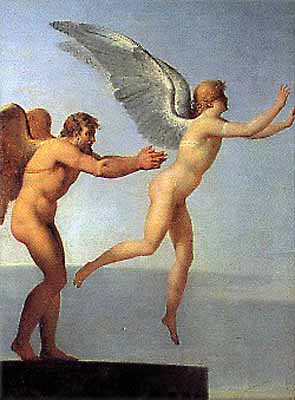
the fallen icarus

1 XI 2007

We were. We are. Or, are we?
I am.
Where to start? Where to end?
I am.

The subject, regardless of his entanglement of social relations, regardless of his past, his self-styled future, and other forms of things of becoming, is ultimately and inevitably alone. He faces a group, a situation, a problem--alone--to acknowledge his oneness with time. By recognizing his solitude, the subject wills something unto himself, and attempts to make sense out of his condition: that is which I call his being. Being, maturing, evolving, morphing through time, faces its inevitable negation in the end--that is death, a subject of void and unthinkable multitude of expanded nothingness. Thus he makes a choice, which results in an act--and life is hence born to him.

The fallen Icarus is an Icarus whom, upon realizing his condition of falling as a result of his own folly, accepts his fate. He is to drown, to perish, to become void. He recognizes that no one else is responsible for his death except for he himself; and he cannot do anything to alter his fate. Nay, Daedalus, he who bequeath power through human invention, the father figure, is distant--and the gods are indifferent to the fate of a mere mortal. He fears his end. He is bewildered to the condition of his destiny: but through reason he realizes that the choice was his, and it was made with no alternative option at hand. It was he, believing in his infallibility, who flew too high so the wax connecting his wings--creation of human genius--and his natural limb melted. He resigns to his fate; but resignation is not enough. He questions its rationale.

We were. We are. Or, are we?
I am.
Where to start? Where to end?
I am.

With this will, the fallen Icarus faces inevitable death, allowing himself to become a part of time, and his being emerges into becoming, and even that strange notion of nothingness is accepted as an understandable part of existence.

Yes, the fallen Icarus speaks to himself in the very moment when ocean swallows his existence, I am.

Random thoughts on the French Revolution

1 XI 2007

It took me a while to finish reading Georges Lefebvre's Coming of the French Revolution; though the book (R.R. Palmer translation, Princeton UP) is not of great length, I have delayed its reading too long for other matters, important or not. So a few things can be said on the book and the subject matter:

1. Lefebvre divides the "revolution" into a few parts, the aristocratic revolution, the bourgeois revolution, the popular revolution, and the peasant revolution. In each time the revolution evolves in scale, though it can also be noted that in each time the revolution loses more sense to create a larger, mass movement with neither direction nor leadership. By the time that the revolution declines into a popular one, can we truly identify figures that dominates enough to direct the movement? No, Sieyes and Mirabeau were certainly figures too cautious to follow these movements; and La Fayette? A hero of both revolutions? Or a member of the dying aristocracy? Movements seem to be stirred by general feelings, i.e. irrational; while movements happened, not even its participants were aware of their historical importance. Hence, the need for bread caused one of the most revolutionary, and horrifying, for that matter, event of human history.

2. In terms of the Declaration of the Rights of Man and Citizen, its meaning is more symbolic than actual--though the replacement of privileges by "rights" calls for the beginning of a new age. The revolution, however, was more than a smooth judiciary change; the irrational part is to play its role soon after.

3. The role that Louis XVI plays in this scenario is ridiculous. Without a charismatic claim to legitimacy, without a rational system of law beyond his position, his inability to effectively use the force of coercion make his legitimacy of tradition very thin. Again, an example of a mediocrity placed in an unfortunate environment.